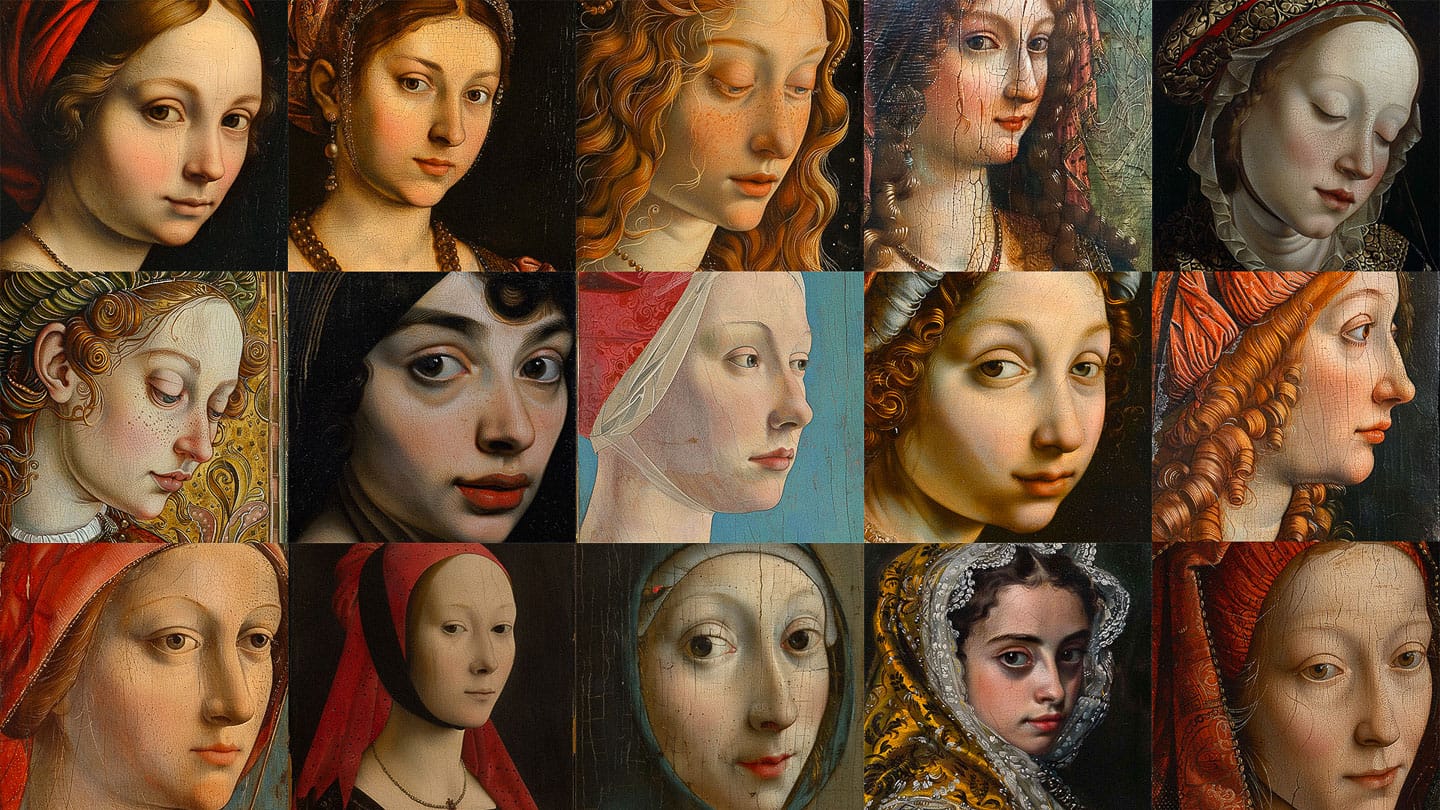
In today’s compilation, we travel in time and unlock the doors to the Renaissance, a period of artistic mastery and innovation that shaped Western art. Through the lens of Midjourney we look at 15 amazing Renaissance styles: from Van Eyck’s intricate realism and Caravaggio’s dramatic light to Raphael’s perfect proportions, and El Greco’s mystical visions.
Titian, a Venetian painter who dominated the 16th century, played a pivotal role in the artistic shift from Renaissance to Baroque. Unlike his High Renaissance counterparts, Titian's focus wasn't solely on ideal beauty and perfect proportions. He revolutionized color use, employing rich, sensuous tones and looser brushwork to create a more dynamic and emotionally charged style.
Piero della Francesca, active in the late 15th to early 16th century, was a master of the early Renaissance known for his mathematical approach to composition and harmonious design. His paintings, predominantly religious, are marked by meticulous attention to detail and a profound sense of balance.
Raphael, a giant of the High Renaissance, stands out for his technical mastery. His compositions, like the famed "School of Athens," are admired for their clarity and balance, showcasing his deep understanding of perspective and geometry. This skill, combined with his use of color and meticulous detail, established him as a leading artist in Rome in his time and secured his place as one of the most influential painters in history.
Michelangelo Buonarroti, an extraordinarely talented Italian sculptor, painter, and architect, epitomized Renaissance art with his Sistine Chapel frescoes and the sculptural masterpiece, the Statue of David. His deep knowledge of anatomy (learned through cadaver dissections), made him a grand master in the depiction of human body. And his architectural prowess is exemplified in Michelangelo’s design for St. Peter's Basilica’s dome in Rome, and helped shape Baroque architectural principles.
Are there many artists who could also be considered engineers? Leonardo da Vinci, a genius of the Renaissance, famous as much for his iconic paintings as for his innovative inventions. This Italian polymath excelled in an astonishing range of fields: from cartography to sculpture, from architecture to engineering, and from anatomy to music!
Jan Van Eyck, a master Flemish painter of the early 15th century, significantly advanced oil painting techniques. His works, notably the "Arnolfini Portrait" and the "Ghent Altarpiece," demonstrate exceptional realism and intricate detail, setting new standards for color and texture in painting, and his innovations profoundly influenced the Northern Renaissance.
Albrecht Durer's artistic style was a blend of technical precision, intricate details, and a fusion of German and Italian Renaissance elements. Known for his mastery of human anatomy, perspective, and light, his works often featured religious and mythological themes and were filled with symbolism and allegory.
Carlo Crivelli was an influential figure in 15th-century Italian painting famous for his devotion to ornate detail and rich textural effects. Unlike other artists of his time who focused on perspective, Crivelli stood out for his love of decoration and almost sculptural detail. His paintings are rich with gold leaf and elaborate designs of drapery, jewelry, and architectural elements. In Crivelli's work, these features often create a dramatic backdrop for deeply spiritual scenes.
Antonello da Messina was a pivotal figure in the 15th century, an Italian painter who introduced oil painting to Sicily. His work, characterized by its realism and meticulous attention to detail, played a significant role in shaping the Renaissance art movement. His portraits often featured classical architecture and the natural landscapes of Sicily as backdrops.
An influential Italian painter from the late 16th century, Caravaggio is renowned for his dramatic and realistic style. His paintings often depict intense religious scenes, characterized by a bold contrast between light and shadow.
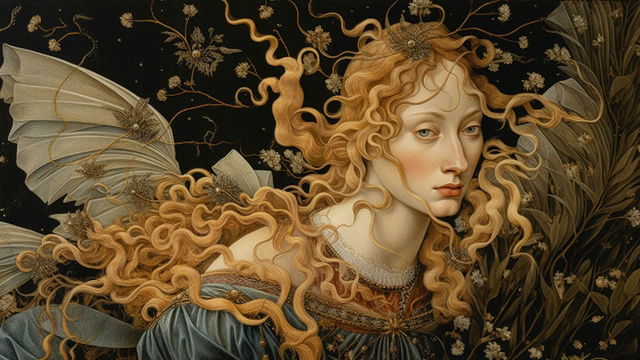
We've previously enjoyed a deep dive into Botticelli's world in our In Focus episode, yet you can never get enough of Sandro Boticelli’s Midjourney style! A standout artist of the Italian Renaissance, born around 1445 and passing in 1510, he stands as one of the foundational pillars of the epoch, whose stunning paintings beautifully capture the elegance and grace of the human figure.
You're likely familiar with Hieronymus Bosch and his astonishing painting, "The Garden of Earthly Delights." A legendary 15th-century Dutch painter, Bosch is known for his complex, surreal, and detailed religious works, filled with bizarre creatures and profound moral themes.
Ambrosius Benson, a talented artist of the 17th century, explored a variety of themes in his paintings, ranging from religious and mythological episodes to portraits. Benson's work is notable for its rich colors, meticulous detail, and elegant execution, all of which are near-perfectly captured by Midjourney.
That’s it for today!
Until next week,
— Maria