Today, we venture into the world of Liu Ye, an artist who grew up surrounded by secret Western books in closed-off China, who learned from Bauhaus masters and mixes Eastern and Western art in the most fascinating manner. Let’s dive into Liu Ye’s journey (and Midjourney)!
Liu Ye was born in 1964 in Beijing during the Cultural Revolution, a time when China was sealed off from the rest of the world. His childhood was unlike many others; his father, a writer of children's books, secretly kept banned Western literature. From a young age, Liu Ye was introduced to the works of Western literature and art. Among these forbidden books were Hans Christian Andersen's enchanting tales and a considerable amount of Russian literature, including works by Alexander Pushkin and Leo Tolstoy. These books, with their vivid illustrations and captivating stories, became the core of Liu Ye's artistic spirit and shaped his creative vision.
From his early years, Liu Ye was trained in painting. In 1980, he was admitted to the School of Arts and Crafts in Beijing, and after graduating with excellent grades, he continued his education at the Central Academy of Fine Arts. During his studies, there was significant interest among the students in Western trends; many dreamed of Bauhaus...
In 1989, just before finishing his studies at the Central Academy of Fine Arts, Liu Ye got a lucky chance through a friend to go to Germany to study at the Berlin University of Arts (Universität der Künste Berlin). This new world was very different from socialist China and amazed Liu Ye infinitely. The Bauhaus style—so beloved by him—and its influence could be seen everywhere!
And the main shock was the wall dividing East and West Berlin, and the difference in the culture of the East and West that Liu Ye felt again but, this time, in a different context. Here in Germany, Liu Ye would not only learn new painting techniques; he would also develop a fundamental thought as an artist: there are many differences between cultures, but there should be no barriers. In his art, he has followed this principle ever since.
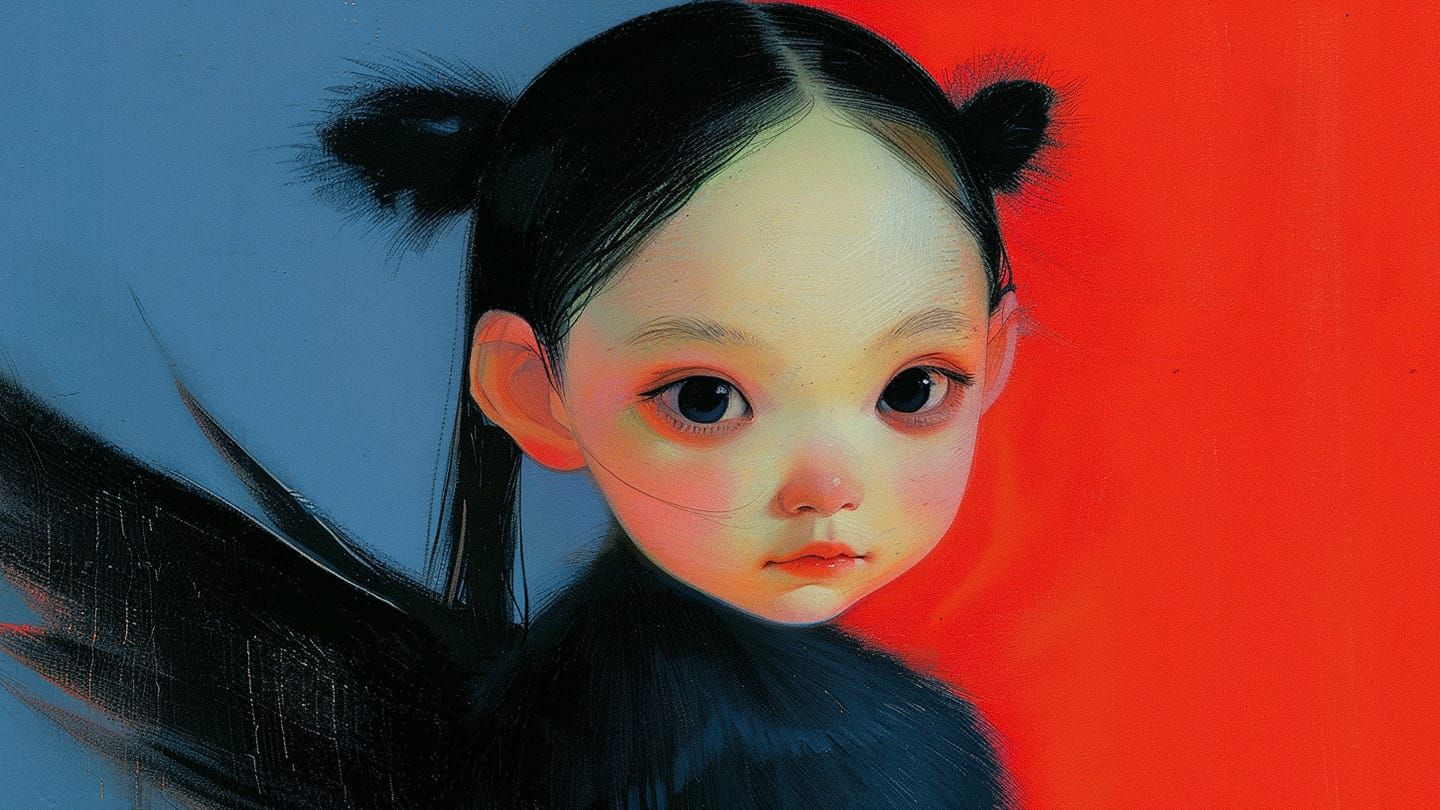
Liu Ye has his distinctive style, yet his paintings are visually flexible; he does not outline strict boundaries for his genre, and minimalism with simplicity sometimes shift to detailed depictions with realistic objects. In his works, Liu Ye mixes the East and the West, the mood and detail of classical art, and pop culture. Through his art, he often reflects his childhood memories, political sentiments, melancholy, and lightness.
One of the main characteristic features in Liu Ye's creativity becomes symbolism and references to what concerns or inspires him. He allows himself in his own works to make direct references to great paintings and famous artists (sometimes simply inserting another artist's painting into his own!) or rewrites in paint the covers and pages of books in his "Books" series, and his works always look original, tender, and gentle. In every stroke, the philosophy of the East is felt, and in the plots, the boldness of the West.
Liu Ye in Midjourney
It's remarkable how well Midjourney recognizes the diverse and nuanced style (and characters) of Liu Ye! To make sure the generated image will accurately capture the mood present in the artist’s original works, try applying Optimal Prompt: .
And be sure to try niji 6!
Unexpected Applications
Midjourney expertly replicates the author's distinctive harmonious color palette, stroke style, detailed rendering, minimalism, and composition. But how about venturing into other styles, like anime or mosaic art, or perhaps even using the artist’s name for a Coca-Cola ad?
Blending Styles
For the final part, let’s see how Liu Ye’s Midjourney style blends with the styles of other authors.
Liu Ye masterfully weaves his personal experiences into his canvases. Ye’s paintings resemble a quiet meditation—where silent observation stirs a blend of memories and emotions, from smiles to tears, drawing you into a moment of gentle joy and subtle reflection.
And Midjourney is great at bringing those cues into the pictures when the artist’s name is mentioned in your prompts.
Until next week!
—Maria
About the authors
I love nature, nude photos, punk hardcore and cats. Bugs collector, art creator
I am a visual artist with 17 years of experience in portrait photography, film, mask design, and education. As Midjourney AI and its analogs are revolutionizing the world of art and our creativity itself, I am overwhelmingly excited to explore the limits of these fantastic new tools and share my findings with the community.