

About
Neoclassicism is an art movement that emerged in the mid-18th century as a reaction to the ornate Rococo style, drawing inspiration from the classical art and culture of Ancient Greece and Rome. It emphasized simplicity, symmetry, and an adherence to classical ideals. Neoclassicism was characterized by its use of clean lines, restrained color palettes, and a focus on subjects from classical history and mythology. Artists sought to convey moral narratives and ideals through their work, often depicting scenes of heroism and virtue.
Observations
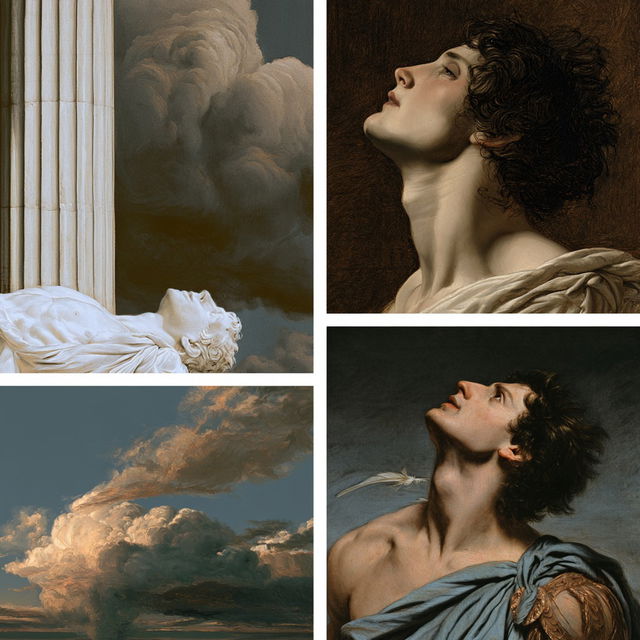
The style combines richly painted, finely worked surfaces with classical Greco-Roman subjects: marble busts, draped figures, monumental columns, temples, and dramatic skies. It shifts between muted dark studies and selective saturated backdrops, while preserving sculptural anatomy, strong profiles, ornate details, and visible fine brushwork throughout.